Carrier Furnace Repair in Alhambra, CA
Answer first: Alhambra Carrier HVAC repairs Carrier gas furnaces across Alhambra, CA, including the Bean Tract and ZIP 91803, reading 59 and 58-series flash codes - 13 limit, 14 ignition, 31 pressure, 34 flame - so call (213) 799-8423 or book online for a no-heat diagnostic. The most common fix is a hot-surface igniter or flame sensor, $150 to $450.
Facts that matter
- Carrier furnace repair across Alhambra, 91801 and 91803.
- Families: 59MN7, 59TN, 59SC condensing; 58-series 80% and Low NOx.
- Most common no-heat fix: hot-surface igniter or flame sensor.
- We read codes 13, 14, 26, 31, 33, 34, 45 directly on the board.
- Diagnostic $109 - $200, usually credited toward an approved repair.
- Typical furnace repair lane $150 - $2,000 depending on part.
- Hours: Weekdays 6am-8pm, emergency service on call.
- Independent shop; in-warranty units referred to an authorized dealer.
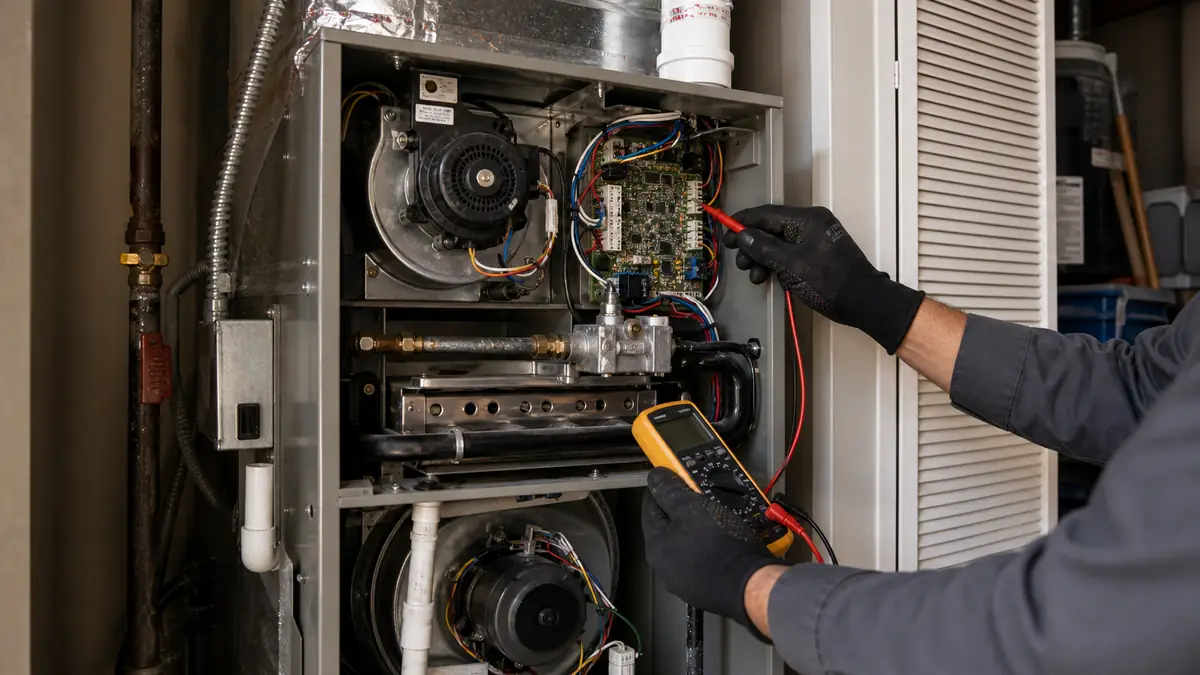
How do you read a Carrier furnace fault code?
Carrier furnaces flash a two-digit code on an amber LED behind the access panel - count the short flashes for the first digit and the long flashes for the second, so three short plus four long is a 34. On an Infinity communicating system, the same code appears on the touchscreen with a plain-language description. That readout points us straight at the failed part instead of guessing. The most common no-heat codes here are 14 (hard ignition lockout), 13 (limit lockout from overheating), and 34 (flame proven then lost - a dirty flame sensor). A 26 rollout code is the one we treat most seriously, because it can indicate a cracked or overheated heat exchanger.
What fails on Alhambra Carrier furnaces?
Mild Zone 9 winters mean a furnace might run only a few weeks a year, so disuse failures dominate: a hot-surface igniter that cracks on the first cold-night cycle, a flame sensor oxidized from sitting idle, a pressure switch or inducer stuck after months off. Here is the triage.
| Symptom / code | Likely cause / first check | Typical cost lane |
|---|---|---|
| Code 14, no flame | Failed hot-surface igniter or no gas | $150 - $450 |
| Code 34, flame then off | Dirty or failing flame sensor | $150 - $400 |
| Code 13 / 33, overheats | Dirty filter, blocked vent, limit switch | $150 - $600 |
| Code 31, won't ignite | Pressure switch or inducer motor | $200 - $900 |
| Code 26, rollout | Inspect heat exchanger (safety) | $200 - replace |
How does a Carrier no-heat call actually go?
A no-heat diagnosis follows the ignition sequence in reverse, checking each stage the furnace must clear to light:
- Read the code. Count the amber flashes (short for the first digit, long for the second) or read the Infinity touchscreen. A 14 says ignition never proved; a 13 or 33 says it overheated; a 31 says the pressure switch never closed.
- Confirm the call and power. 24V to the board, line voltage, and a closed limit. A blown control fuse throws code 24 and stops everything.
- Check the inducer and pressure switch. The inducer must pull a draft and close the pressure switch before the board lets gas flow. A stuck switch or a blocked flue is a frequent disuse failure.
- Test the ignition train. Hot-surface igniter resistance and glow, gas-valve operation, and flame-sensor microamps. A sensor reading under about 1 microamp drops flame and throws code 34.
- Inspect for safety trips. A rollout switch (code 26) sends us to the heat exchanger with a camera and combustion analyzer before we let the furnace run again.
Working the sequence in order means we replace the part that actually failed - not the igniter when the real fault was a dirty flame sensor or a stuck pressure switch.
Which Carrier furnace families do you repair?
- Infinity condensing (59MN7 modulating ~98% AFUE, 59TN7/59TN6 two-stage variable-speed). These pair with the Infinity control, so faults show as numeric codes plus plain language on the touchscreen.
- Performance/Comfort condensing (59TP6, 59SC6 single-stage 95-96%). Standard board with the amber flash code; diagnosed at the board LED.
- Ultra-Low NOx (59CU5 Infinity 95, 58CU0). Built to meet California's tighter NOx limits; the replacement many Alhambra furnaces must move to.
- 58-series 80% AFUE. The simplest tier, common and often adequate in mild Zone 9. Igniter, flame sensor, and pressure-switch faults dominate.
What does a Carrier furnace repair cost in Alhambra?
- Hot-surface igniter, $150 to $450. The classic first-cold-night failure; part plus labor.
- Flame sensor clean or replace, $150 to $400. Often just a cleaning restores the microamp signal.
- Pressure switch or inducer, $200 to $900. A stuck switch is cheap; a seized inducer motor is the higher end.
- Control board, $400 to $900. More for an Infinity communicating board.
- Limit switch / airflow correction, $150 to $600. Often just a filter and a static-pressure check.
- Cracked heat exchanger. Not a repair we patch - on an older 58-series this tips to replacement, $3,000 to $7,500 for a new furnace.
Repair or replace an older Carrier furnace?
If the heat exchanger is cracked or the furnace is past 15 to 20 years and needs a major part, replacement is usually the call - and in California you will likely move to an Ultra-Low NOx model like the 59CU5 to meet emissions rules. A full furnace replacement runs $3,000 to $7,500 depending on efficiency tier. If it is just an igniter or flame sensor on an otherwise sound 59-series, the repair is cheap and quick. We show you the heat-exchanger inspection so the decision is yours, not a sales pitch. For heating-and-cooling-in-one alternatives, see Carrier heat pump installation.
Common questions
What does a 13 or 14 flash code mean on my Carrier furnace?
Code 13 is a limit-circuit lockout - the furnace overheated, usually from a dirty filter, blocked vent, or low airflow. Code 14 is a hard ignition lockout, meaning flame never established after several tries, often a failed hot-surface igniter, no gas, or a dirty flame sensor. Both are read as short and long amber flashes on the control board.
Why does my Carrier furnace start then shut off after a minute?
Short-cycling on heat often points at a dirty flame sensor (code 34, flame sensed then lost) or a marginal limit switch tripping on heat buildup (code 33). A clogged filter starving airflow is the most common root cause in dusty older Alhambra homes. We clean and test the sensor and check static pressure before replacing parts.
Is a cracked heat exchanger dangerous, and how do you find it?
Yes - a cracked heat exchanger can leak combustion gases. A rollout switch tripping (code 26) is a red flag we never ignore. We inspect the exchanger with a camera and combustion analyzer. If it is cracked on an older 58-series furnace, we shut it down and walk you through repair-versus-replace honestly.
Do Alhambra homes even need much furnace repair?
Heating load is light here - Zone 9 winters are mild - but that is exactly why furnaces sit unused for months and then fail on the first cold night. Igniters crack, flame sensors oxidize, and pressure switches stick from disuse. A quick pre-season check on a 59 or 58-series Carrier furnace prevents most no-heat calls.
Why does my furnace smell like burning dust when it first runs?
That is usually harmless - dust that settled on the heat exchanger over a long idle SoCal summer burning off in the first few cycles, and it clears within an hour. What is not harmless is a sharp electrical or sulfur smell, or one that lingers; those warrant shutting the furnace off and a diagnostic, since they can signal a wiring fault or a combustion problem.
Is a yellow furnace flame a problem?
Yes. A healthy Carrier burner flame is steady and blue; a lazy yellow or orange flame points at incomplete combustion - often a dirty burner, a cracked heat exchanger, or a venting problem - which can produce carbon monoxide. If you see yellow flames, shut the furnace down and have us inspect the burners and heat exchanger with a combustion analyzer before running it again.