Carrier Code 31 (Pressure Switch / Draft Fault) in Alhambra
Answer first: A Carrier code 31 in Alhambra, CA (Emery Park, ZIP 91801) means the pressure switch did not prove draft - a blocked flue, weak inducer, cracked sensing tube, or plugged condensate trap. Call (213) 799-8423 or book online and we test the draft and pressures the same week.
Facts that matter
- Carrier 31 diagnostics across Alhambra (91801, 91803).
- Code 31 = pressure switch did not close or reopened mid-cycle.
- Common causes: blocked flue, weak inducer, cracked tube, plugged trap.
- Inducer motor about $300 to $700 installed.
- Pressure switch about $150 to $350.
- Flue or condensate-trap clearing within a diagnostic visit.
- The lockout is a safety - never bridge a pressure switch.
- Independent shop; in-warranty units referred to an authorized dealer.
What does code 31 mean on a Carrier furnace?
Code 31 is a pressure-switch fault, sometimes logged with the HPSR relay note. Every Carrier 80-percent and 90-percent furnace runs a draft-proving sequence: on a call for heat the inducer motor spins up first, and the negative pressure it creates pulls a small diaphragm switch closed. That closed switch is the board's proof that air is moving through the heat exchanger and flue before any gas lights. If the switch does not close within the timing window, or if it closes and then reopens mid-burn, the control posts 31 and halts ignition. It is counted as three short amber flashes followed by one short flash on the control board, or shown in plain text on an Infinity touchscreen. The point is simple: no proven draft, no flame, every time.
Why does my Carrier furnace throw code 31 in Alhambra?
Alhambra's housing stock decides where this fault hides. The western San Gabriel Valley is packed with 1920s Spanish Colonial revival and Craftsman homes around Emery Park and Bean Tract, and many of those furnaces vent up an original masonry chimney or a long horizontal run added during a remodel. Birds and the leaf litter that builds against the foothills clog those flue caps, and a partially blocked vent is the number-one draft killer we find on a 31. Tudor and storybook cottages in Granada Park often have furnaces crammed into tight hall closets where the inducer wheel cakes with dust and slows down. On the newer 90-percent condensing units across Midwick and the Colonial-revival Orange Blossom Manor tract, the culprit shifts: the condensate trap plugs, water backs into the pressure tubing, and the switch can no longer sense draft. Add the valley's short, hard winter rain bursts that push a downdraft through an uncapped flue, and you have the whole 31 family in one city.
How do you diagnose a Carrier 31 code?
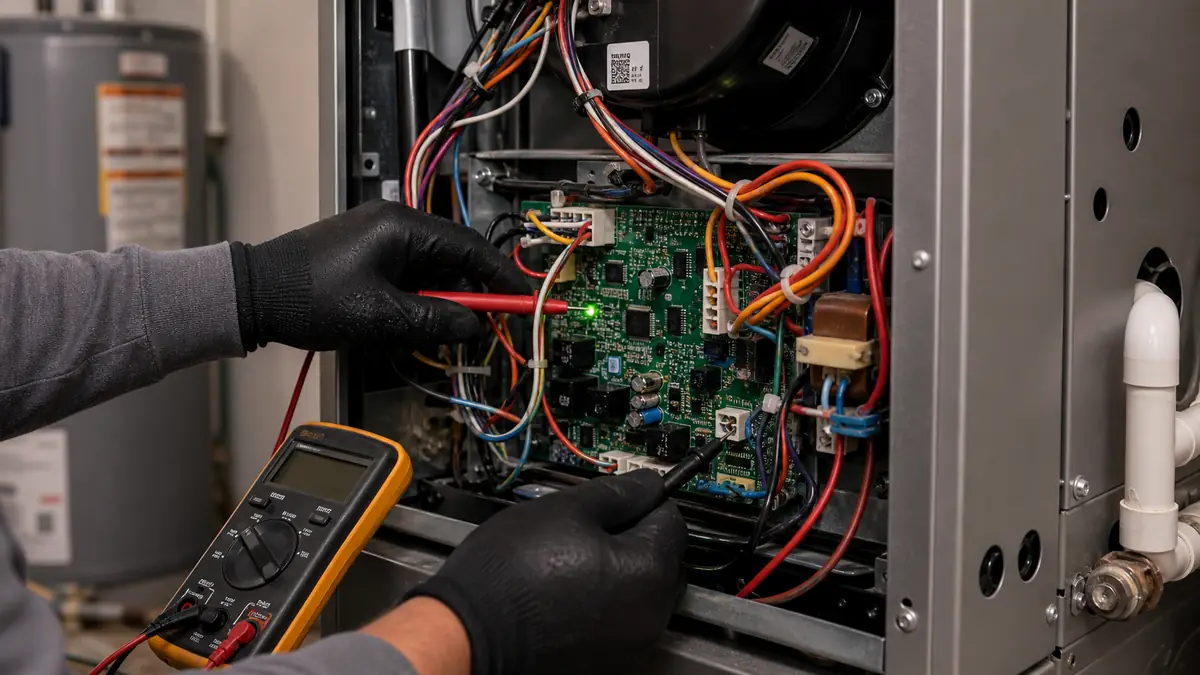
We work the draft chain in order, with instruments, not guesses. First a manometer reads the actual negative pressure the inducer pulls at the switch port, in inches of water column, and we compare it to the rating stamped on the switch - a 90-percent unit often needs around negative 0.50 to 1.50 in. w.c. to close. If the inducer makes pressure but the switch never closes, the switch is bad. If the inducer cannot make pressure, we trace upstream: pull and inspect the sensing tubing for cracks, soot, or condensate, check the inducer wheel and motor amperage against the nameplate, and scope the flue for a nest, screen, or crushed section. On condensing furnaces we clear and fill the condensate trap, since a slug of water there fakes a draft fault perfectly. We also confirm 24-volt power to the inducer and the HPSR relay so a wiring or relay problem is not mistaken for a mechanical one.
| What we find | Likely cause | Typical cost lane |
|---|---|---|
| Inducer pulls draft, switch never closes | Failed pressure switch | $150 - $350 |
| Inducer slow or noisy, low amps | Weak or failing inducer motor | $300 - $700 |
| Switch closes then reopens mid-burn | Plugged condensate trap or flue restriction | Within a visit |
| Tubing soft, cracked, or full of water | Sensing tube fault | Within a visit |
| Nest or debris at the flue cap | Blocked vent (common near the foothills) | Within a visit |
What can I safely check before calling on a 31?
Three checks are safe and fix a real share of these. One: pull the air filter - a filter so clogged it starves the burner section can knock the pressure reading off and trip 31, and a fresh filter is free. Two: walk outside and look at the flue termination. If you can see leaves, a bird nest, or a wasp build-up at the cap, that is your draft block; clearing what you can reach from the ground is fair game. Three, on a high-efficiency condensing furnace with a white PVC vent: check the condensate drain and trap for standing water or a slow drip, since a backed-up trap is a frequent 31 on those units. After any of these, cut power at the switch for a full minute to clear the lockout and watch one complete cycle. What stays off-limits is the switch itself - never bridge, jump, or tape a pressure switch closed to force a run, and never reset repeatedly through a fault that keeps returning. Reading manometer pressures, replacing an inducer, or scoping a flue is meter-and-ladder work for a tech.
When is a Carrier 31 urgent?
The 31 lockout is doing its job by refusing to fire, so a single posted code is not an emergency - it is a stalled furnace, not a gas hazard. Treat it as urgent in two cases. First, if you smell exhaust or combustion odor near the furnace, shut it off and call now: a draft fault paired with a smell can mean flue gas is spilling instead of venting. Second, in a cold snap where a home with older occupants or pets has no heat, get on the same-week schedule rather than nursing repeated resets. Most Alhambra winters are mild, but the valley's overnight lows still matter in an uninsulated 1920s cottage. For related furnace faults, see our Carrier fault codes hub, and if the furnace will not heat at all, our no-heat troubleshooting page covers the wider checklist. When you are ready, furnace repair lays out the visit.
Common questions
What does code 31 mean on my Carrier furnace?
Code 31 means the pressure switch did not close on a call for heat, or it opened mid-cycle. The switch confirms the inducer motor is pulling combustion air and venting flue gas. No proof of draft, no ignition - the board halts the sequence on purpose so unburned gas never enters a dead vent.
Can I clear a Carrier 31 code myself?
Sometimes. Swap a clogged filter, confirm the flue cap outside is clear, and on a 90-percent furnace check the condensate trap and drain for standing water. Cut power for a minute to reset, then watch one cycle. If 31 returns, the inducer, switch, or tubing needs a meter - that is our visit, not a homeowner fix.
Is a Carrier code 31 dangerous to keep running?
The lockout itself is the safety - it stops the burners until draft is proven, so the furnace will not run unsafely. The risk is overriding it. Never jump or bridge a pressure switch to force a start. If you smell exhaust, hear repeated clicking with no heat, or the furnace short-cycles on 31, shut it off and book a draft check.
How much does fixing a Carrier 31 code cost in Alhambra?
It depends on the part. Clearing a blocked flue, slipping a cracked sensing tube, or flushing a plugged condensate trap usually falls within a single diagnostic visit. A weak inducer motor runs about $300 to $700 installed, and a failed pressure switch is roughly $150 to $350. We quote the exact lane before any work starts.