Carrier Code 44 (Excessive Air-Delivery Restriction) in Alhambra
Answer first: A Carrier code 44 in Alhambra, CA (Bean Tract, ZIP 91803) flags excessive air-delivery restriction - a clogged filter, closed dampers, a crushed duct, or undersized ductwork choking the blower. Call (213) 799-8423 or book online and we measure static pressure to find the choke point fast.
Facts that matter
- Carrier 44 diagnostics across Alhambra (91801, 91803).
- Code 44 = Infinity control sees excessive airflow restriction.
- Common causes: clogged filter, closed dampers, blocked or undersized duct.
- We measure total external static pressure to locate the choke.
- Filter or duct fix from minor up to about $600.
- Blower/ECM motor about $450 to $2,300 if damaged.
- Restriction makes the coil ice and the compressor labor.
- Independent shop; in-warranty units referred to an authorized dealer.
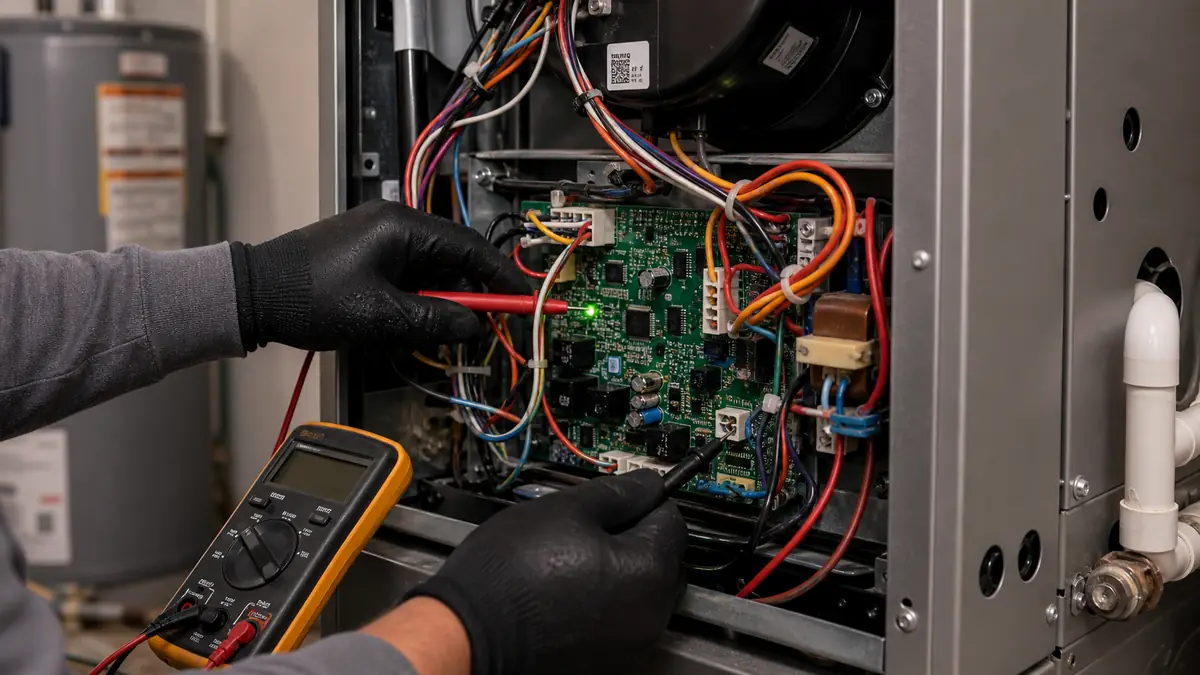
What does code 44 mean on a Carrier Infinity system?
Code 44 is the Infinity control telling you the air side is choked. A Carrier communicating system pairs a variable-speed ECM blower with an indoor board that constantly watches how hard the motor works to deliver its commanded airflow in cubic feet per minute. The blower ramps its torque to hit that target, and the board tracks the static pressure it fights along the way. When that resistance climbs past the design ceiling - roughly 0.5 in. w.c. on a healthy system, and these duct systems often run far higher - the control logs 44 to flag that air delivery is restricted. It is a protective warning, not a hard lockout: the system keeps trying, but the motor is straining, the coil is starved, and cooling capacity drops. Catch 44 early and it is a filter; ignore it and the blower or coil pays.
Why do Alhambra homes trip Carrier code 44?
The honest answer in Alhambra is ductwork age. This is a city of 1920s Spanish Colonial revival, Craftsman, and storybook cottages, and central air was almost never original to those homes. The ducts got retrofitted decades later, snaked through tight attics and crawlspaces around Emery Park, Alhambra Vista, and Midwick, and they are frequently undersized or kinked for the tonnage a later contractor bolted on. Hot western San Gabriel Valley summers push owners to run the system hard, which is exactly when an already-tight duct trips 44. The valley heat-island effect keeps attics brutal, and brittle old flex duct sags or collapses where it crosses a rafter. We see closed or stuck zone dampers in the larger Colonial-revival Orange Blossom Manor homes, undersized returns in cottages that only ever had one central grille, and filters left in far too long because the rack is buried in a hall ceiling. Each one shows up as the same 44.
How do you track down a Carrier 44 restriction?
This fault is solved with a static-pressure test, the HVAC equivalent of a blood-pressure cuff for the duct system. We drill or use existing ports to read static on both sides of the air handler and add them for total external static pressure, then compare it to the blower table for your model. A high number confirms 44 is real and tells us how severe the choke is. From there we isolate it: pull and inspect the filter and its rack size, open every supply and return register, walk the accessible duct for crushed or disconnected flex, check zone dampers for stuck-closed actuators, and inspect the indoor coil for ice or a mat of dust that blocks face area. On an Infinity system we also read the blower's reported airflow and torque in the installer menu, which shows whether the ECM is compensating hard or already throttling back. That separates a five-dollar filter from a duct-redesign conversation.
| What we measure | Likely cause | Typical cost lane |
|---|---|---|
| High static, clears with new filter | Clogged or oversized-MERV filter | Minor / within a visit |
| High static at one register | Closed or stuck zone damper | Within a visit |
| High return static | Undersized or blocked return grille | Up to about $600 |
| Crushed or disconnected flex run | Damaged duct in the attic | $150 - $600 |
| High static system-wide, ducts OK | Undersized duct for the tonnage | Duct redesign quote |
| Blower noisy, drawing high amps | ECM strained or failing | $450 - $2,300 |
What can I safely check before booking a 44?
Plenty of 44 codes clear with homeowner basics, and they are all safe. Change the filter first and check the size on the frame - a thick high-MERV filter crammed into a rack built for a 1-inch pleated can itself choke airflow enough to trip 44, so match what the unit was designed for. Walk the house and open every supply register and return grille; rugs over a floor return, a couch shoved against a wall grille, or closed bedroom dampers all starve the blower. If you have a zoned Infinity system, confirm no zone is calling for a setting that parks its damper shut. Then run a full cooling cycle and see if 44 comes back. What is not a homeowner job: reading static pressure, opening duct to find a collapsed run, pulling and cleaning an iced indoor coil, or judging whether the duct system is simply undersized for the tonnage. Those need a manometer and a look inside the attic, and forcing the system to run on a chronic restriction is how a healthy ECM blower turns into a $450 to $2,300 replacement.
When does a Carrier 44 become urgent?
A 44 will not hurt anyone, but it quietly costs money and comfort, so do not let it ride through an Alhambra heat wave. The order of damage runs like this: a starved coil drops below freezing and ices over, which cuts cooling to nothing right when the valley is hottest; the iced coil then floods the drain pan and can leak; and the ECM blower runs at maximum torque for hours fighting the choke, shortening its life. If your system is also short-cycling, blowing warm, or you see water near the air handler, treat it as a same-week call rather than a someday repair. For the cooling-loss side, our AC not cooling page walks the wider checklist, the Carrier fault codes hub covers the related comm and limit codes, and when a duct or coil repair is needed, AC repair lays out the visit.
Common questions
What does code 44 mean on a Carrier Infinity system?
Code 44 means the Infinity control measured more static pressure than the blower should fight - excessive restriction in air delivery. The variable-speed ECM tracks how hard it works to move rated airflow. When resistance climbs past its limit, it logs 44 to warn that something is choking the duct system before the motor or coil suffers.
Is Carrier code 44 the same as a dirty filter?
A clogged filter is the most common single cause, but 44 is broader. It flags any excessive restriction: a collapsed flex duct, closed or stuck zone dampers, a blocked return grille, an iced indoor coil, or ductwork simply too small for the tonnage. We measure total external static pressure to tell a filter problem from a duct-design problem.
Can I fix a Carrier 44 code myself?
Start with the easy wins. Replace the filter, make sure every supply and return grille is open and unblocked by furniture or rugs, and confirm no zone dampers are stuck shut. Then run a cycle. If 44 returns with a clean filter and open vents, the restriction is inside the ducts or coil - that needs a static-pressure reading and is our visit.
What does it cost to clear a Carrier 44 in Alhambra?
The fix tracks the cause. A filter swap or opening a blocked return is minor. Sealing or replacing a crushed duct run climbs toward about $600, and if the blower ECM has been damaged by fighting the restriction, a motor runs roughly $450 to $2,300. We read static pressure first, then quote the actual repair lane before any parts.